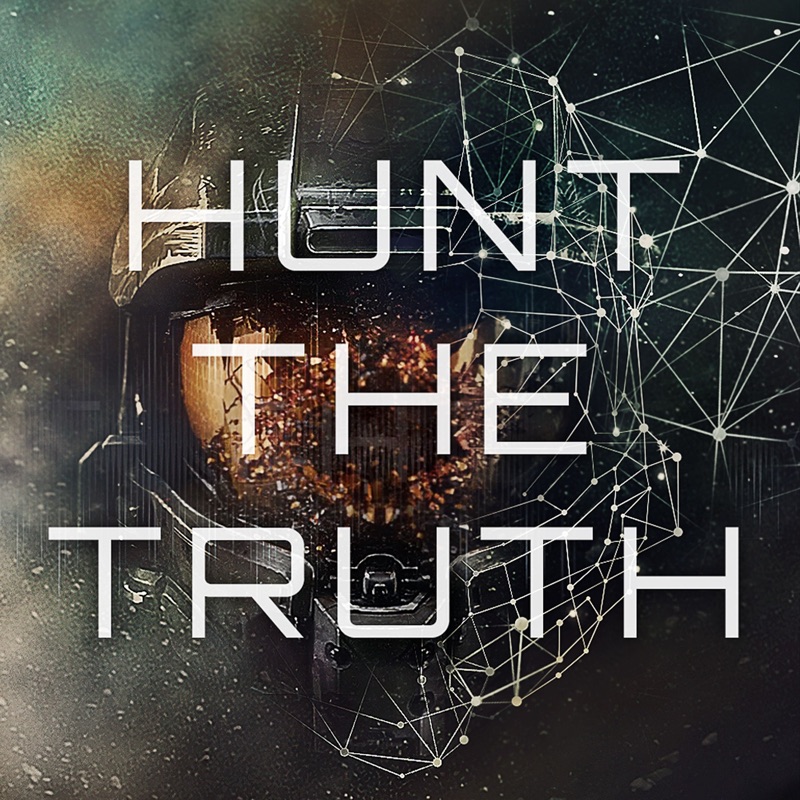
A surprising turn of fortune for the Halo Extended Universe
Depressingly often, the rule of thumb with Halo's extended universe was that it existed as fan service. It did nothing to attract new customers, diversify the demographics, only to expand the already compelling game-world developed by Bungie and their successor, and to appease inquisitive die-hards between games.
Not so with Hunt the Truth. Admittedly, a lot of this play's dramatic tension derives from a long-standing player's investment in the heroism of the master chief, and their desire to see a character who, arguably, is a somewhat monolithic icon of agency from many of our childhoods - exonerated of the horrible crimes levelled at him. However - Hunt the a Truth's writer has navigated the pitfalls of episodic releases masterfully - creating a story which stands on the merits of its own perfectly rhythmic pacing and its compelling main character, Ben.
Ben Giraud, the narrator, undergoes a process that is quite alien to the Halo series. Character development. Whilst I love the Halo series, 343i seem, as again evidenced by the train wreck "Nightfall", completely incapable of creating compelling characters to drive their narrative. Whilst Ben is not a nuanced as could be desired - his progression from lap-dog to paranoid revolutionary, and his excellent emotional range (credit to Keegan Michael-Key) , and frankly, the fact that he, unlike most Halo characters, isn't some military pastiché, jacked on ego and detest of brain-power, but just a normal guy with relatable problems of money and inadequacy - means we are far more invested in his plight than any other area of Halo's canon.
Halo's awe-striking, ancient universe - Forerunners, Covenant, Ancient Humans - all of the wonder that drives the typical Halo story is absent, (save for a vividly and imaginatively written stride across a glassed planet - something I have always wanted to see), and why? Because it isn't needed. The intrigue, the driving voice of Ben, the relatable and strangely relevant-to-today struggles against the omnipresent fictional intelligence firm ONI - an agency who, for currently indiscernible reasons, oppresses and deprives humanity of what NSA has learned we all crave - truth - these keep us listening (I listened to the whole thing back to back until 3am). The beauty, the awe, the humanity wide gravity of the series have their place, but this return to storytelling of less ambition have ironically yielded the best results in years.
ONI is a master stroke of a villain - 343i have matched them expertly with the medium, here. The disorientation of having nothing but spoken word and imagination lends itself naturally to the paranoia ONI impress into every corner of this piece's civilisation. They are ethereal, cruel, and indomitable - and if I can give any more praise at all - it would be to say that at times I felt genuine anger and their methods and results.
This has given me hope for the Halo series. 343i may not seem to have the narrative tact to develop character in their games - and the continued personification of the eclectic Forerunners seems to be sapping away the wonder of the series and replacing it with sadly recognisable clichés - but this play and it's centre-piece villain have piqued my interest again.
(Foot note: If I could make one criticism, it would be the writer's perception of future culture. Granted, the podcasts closing episode relies on frustration at recognisable american tropés of a corrupt, money-obsessed media and patriotism - but to many foreigners, the americanisms will set your teeth on edge. I cringed at the military worship - particularly the line "always good to see a veteran in uniform", the use of "patriot" as a compliment, and the mention of the fact that this culture retains the death penalty, but these are ornery frustrations.)